The hardest financial moment isn't always when the clinic is obviously failing.
The clinic looks busy. Therapists are moving room to room, the phones ring, and the notes get done, late, but done. From the outside, nobody would think anything is wrong.
Then the month-end numbers come in, and the bank account doesn't match the month everyone thought they had. You might even be awake at 2 AM, wondering whether payroll is going to clear in a clinic that looks successful from the outside.
That's the part of ownership most people leave out. Sometimes the clinic looks fine, the schedule stays full, and the money still doesn't show up the way it should.
You're not bad with numbers. You stopped getting answers from them.
You have plenty of numbers. The EMR has a report. The billing company has a report. The accountant has a report. None of them quite agree, so you stop trusting all of them. That's a frustrating place to be: surrounded by data and still not sure what to change.
So the financial questions get pushed to the end of the day. After dinner. After the notes. After a hundred decisions, when there's nothing left for a report that might tell you something you don't want to see.
It isn't laziness, and it isn't that you can't do the math. Nobody ever showed you which handful of numbers actually matter, or what to do when one of them is off. A dashboard reports the number. It leaves the deciding to you, with nothing to help you make the call.
And busy can hide the problem. More evals, more visits, fewer empty slots. The schedule looks strong, but the cash still doesn't follow the way it should. In most therapy clinics, the work happens now and the money shows up later, assuming billing goes the way it should. A visit becomes a claim. Then it becomes a payment, a denial, a partial payment, or a write-off. That gap between work performed and cash collected is where the surprise grows.
What Clinic Vital Signs actually is
Clinic Vital Signs is a Google Sheets workbook, User Guide, and decision playbook for PT, OT, and SLP clinic owners. It helps you review the few numbers that tell you whether the business underneath the schedule is working the way it should.
You already understand vital signs. You don't run every test every visit. You watch the few numbers that tell you whether someone is stable and what needs attention. Your clinic has vital signs too, and Clinic Vital Signs points that same habit at the business.
It isn't accounting software, and it isn't another dashboard. It's a small set of numbers, reconciled to what actually hit the bank, with the decision written next to each one.
Every Monday, in about fifteen minutes, you check three numbers:
- How full your schedule is this week and next
- New evals on the books this week and next
- Last week's arrival rate
One number looks back. Two look forward. They won't tell you your profit. They'll tell you what kind of month is taking shape while there's still time to act.
Once a month, you check the deeper numbers:
- What you actually collect per visit
- Your break-even, with a real salary for your own time built in
- AR over 90
- Which clinicians and payers carry the clinic
The Monday Margin Check helps you catch problems early. Clinic Vital Signs helps you with the deciding part: understanding what's causing the problem and what to do next.
What you get
The Clinic Vital Signs workbook. A Google Sheets workbook with a Monday tab and a Month-End tab. Enter the numbers and it does the math, reconciled to your bank, with the decision rule next to each number.
The User Guide. A plain-English explanation of where each number comes from and how to pull it, so you're not guessing at inputs.
The decision playbook. For every number, the moves to make when it's off, in the order to try them. This is the interpretation, the part most reports leave out.
The Monday Margin Check guide. The weekly habit in a short guide, so you can review the three Monday numbers and start spotting problems earlier.
You own it. No subscription.
A look inside
Here's the workbook itself. The Monday tab you fill in about fifteen minutes, the Month-End tab that reconciles to the bank, and the decision playbook that tells you what to do when a number's off.
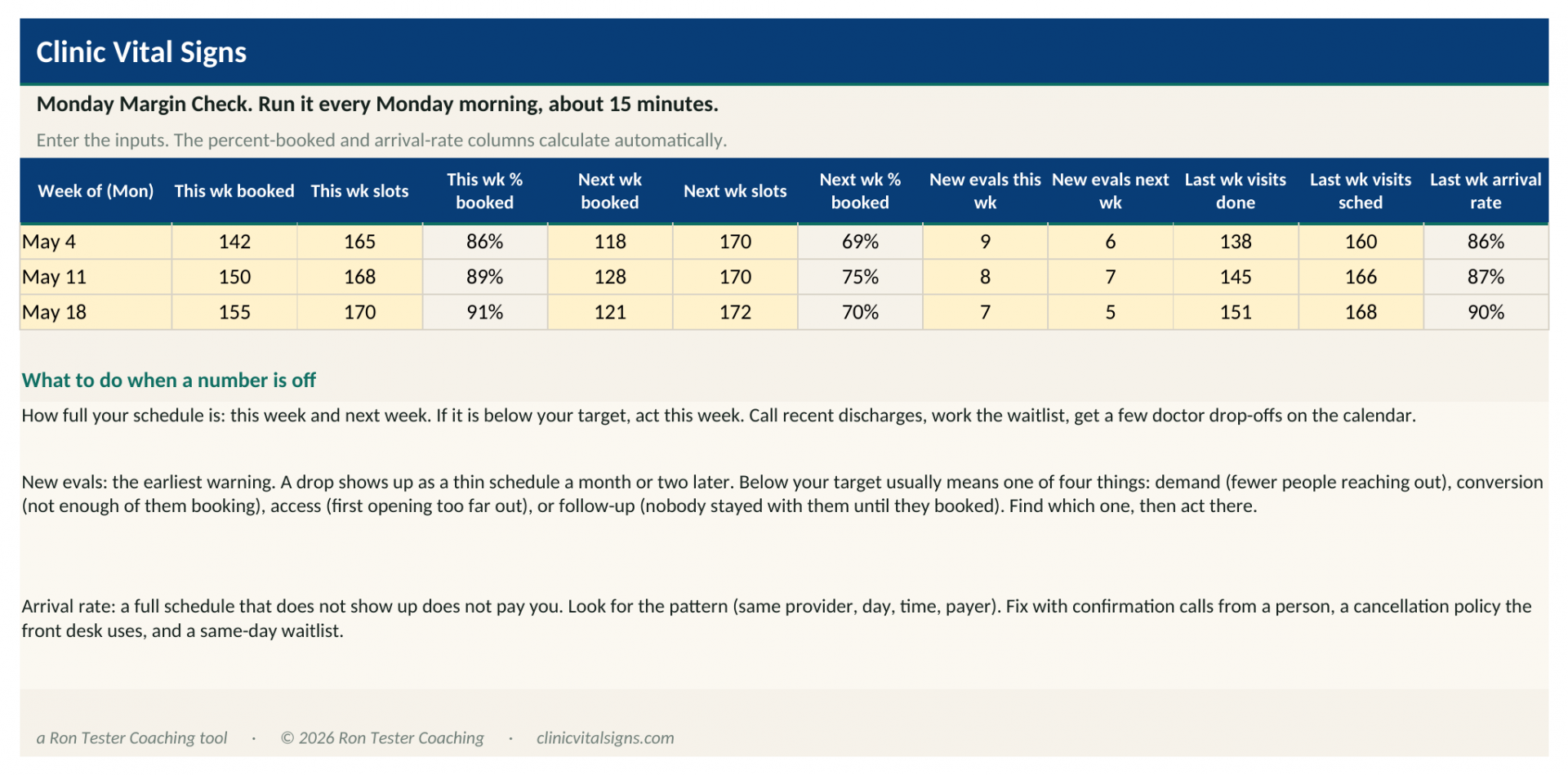
The Monday tab: three numbers, about fifteen minutes.
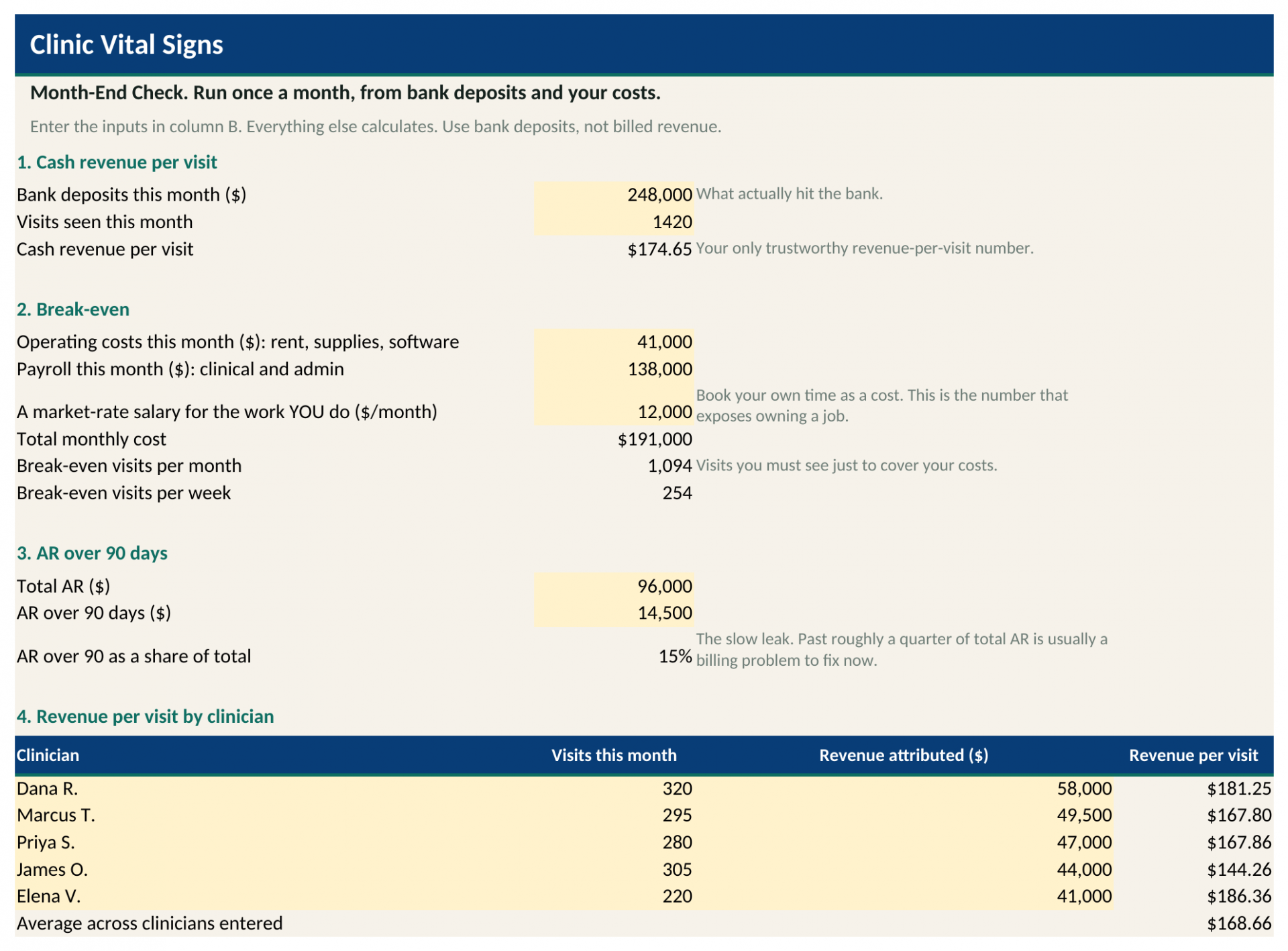
The Month-End tab, reconciled to what actually hit the bank.
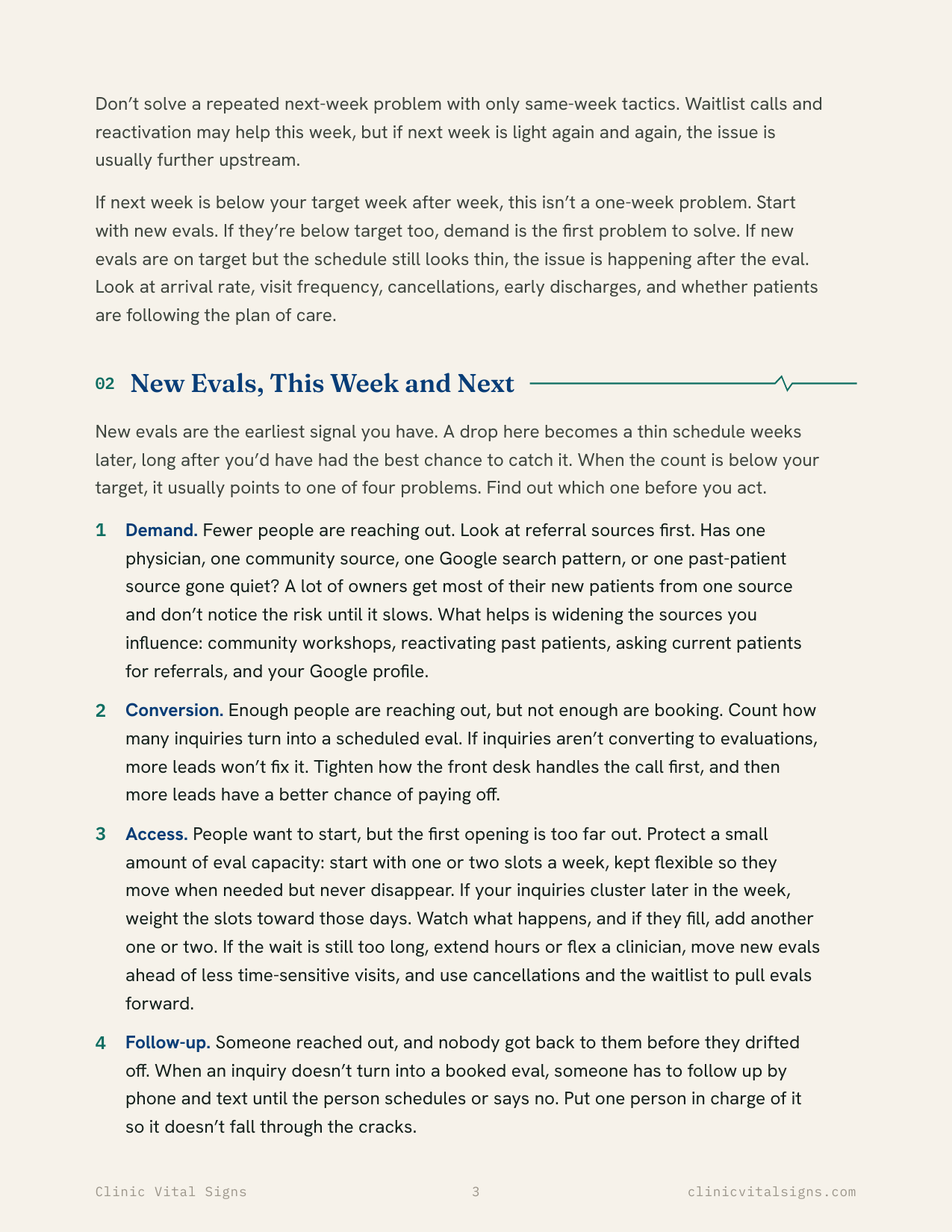
The decision playbook: what to do when a number's off.
Use it for 30 days. Run one Monday check and one month-end review. If it doesn't show you at least one number worth acting on, email me and I'll refund you. No back-and-forth.
Why this is different
Most of what gets sold to clinic owners is measurement. Free productivity calculators, KPI dashboards inside your EMR, industry benchmark reports that tell you where you ranked last year. Those tools can be useful, but they usually stop at reporting. Clinic Vital Signs helps you with the deciding part.
I built this from the owner side of the table. I owned service businesses. I read these P&Ls. I sat in the bank parking lot doing the math I'd been putting off. I know what it feels like to have a full schedule and still wonder whether the business is working. I've also spent years coaching PT, OT, and SLP owners through these decisions.
The numbers in Clinic Vital Signs are the ones that help you see what's happening in the business, in plain language, with the next move attached.
Who it is for
- PT, OT, and SLP clinic owners
- Owners whose schedule is full but who aren't sure the business underneath it is healthy
- Owners who are tired of finding out how the month went at month-end
- Owners who want a few numbers they trust, not a finance degree
- Owners who want to make better decisions about staffing, payers, collections, and owner pay
Who it is not for
- Owners who want someone else to look at the numbers so they never have to
- Owners looking for accounting software or a bookkeeping replacement
- Owners who want a full financial review done for them
- Owners who aren't ready to look directly at what the numbers are saying
This sits on top of your existing systems. It helps you understand what the numbers mean and what to do next.
The investment
Think about what not knowing can cost. Hiring before the numbers support it. Keeping a payer that fills the schedule but weakens the business. Letting old AR sit because nobody's watching the trend. Staying full while the clinic still doesn't pay the owner well. Any one of those decisions or blind spots can cost more than Clinic Vital Signs.
Clinic Vital Signs
$197
one time · you own it · no subscription
The workbook, the User Guide, the decision playbook, and the Monday Margin Check guide. The few numbers that tell you whether the business is working, with the next move attached.
Get Clinic Vital Signs for $197Use it for 30 days. Run one Monday check and one month-end review. If it doesn't show you at least one number worth acting on, email me and I'll refund you. No back-and-forth.
Questions owners ask
"I don't have time for another spreadsheet."
The Monday check takes about fifteen minutes a week. The month-end review takes more time, but it's built for owners who already have too much on their plate. You're not trying to become an accountant. You're trying to understand the few numbers that tell you where the clinic needs attention.
"I've tried tracking my numbers before and it didn't stick."
Most tracking fails because it reports and then leaves you alone with the numbers. Clinic Vital Signs shows you what to check and what to change when a number is off. That's the part that makes the numbers useful.
"I'm not a numbers person."
You don't need to be. You enter a few figures, review the results, and use the decision playbook to understand what needs attention. The point is to keep the system small enough that you'll actually use it.
"Every clinic is different."
True. That's why Clinic Vital Signs helps you understand your numbers and your trend, not someone else's benchmark. Your right number isn't always the same as another clinic's. Your direction over time matters.
"Can I figure this out myself?"
You might. The question is what another year of guessing costs. If the numbers support the decision, you should know. If they don't, you should know before the hire, the payer contract, the missed collection pattern, or the owner-pay problem gets more expensive. Clinic Vital Signs gives you the numbers to watch and the decisions to make when one of them is off.
You don't need to become a CFO. You need a few numbers you trust, a simple rhythm for reviewing them, and a clearer way to decide what to do next. That's what Clinic Vital Signs gives you.
Work through it on your own. That's how it's built. And if you get into the numbers and want a second set of eyes on what they're telling you, that's the work I do with owners every week.
Use it for 30 days. Run one Monday check and one month-end review. If it doesn't show you at least one number worth acting on, email me and I'll refund you. No back-and-forth.